

Rural America Is Growing. Now Growth Has To Work For Rural People.
Economic momentum only matters if it reaches the people and places behind it. The real test is whether more rural communities can turn growth into good jobs, stronger local businesses, and opportunity that lasts.
Rural America is growing. Its economy is producing more, employment has regained some momentum, and certain regions are attracting new residents, businesses, and investment.
But growth on paper does not always translate into greater economic security for rural people. A community can generate more output without creating enough jobs, raising wages, expanding local business ownership, or building household wealth. National indicators may point toward a strong economy while people experience something very different through the jobs available to them, the prices they pay, and whether their community feels like it is gaining ground.
This disconnect matters even more as the country enters another period of rapid technological and economic change. Artificial intelligence is driving major investment in data centers, energy systems, and other infrastructure, much of it located in rural areas because of the availability of land, water, and power.
That investment could create opportunities. But using rural assets to support national growth is not the same as investing in rural workers, businesses, and communities. Without deliberate local strategies, rural places can host the infrastructure of the next economy without fully sharing in the prosperity it creates.
The latest data points to three defining trends:
- Rural economic output is growing, but the benefits are not reaching everyone.
- Structural barriers continue to limit job creation, entrepreneurship, and wealth-building.
- Rural momentum is growing, with the West driving much of it.
Together, these trends reveal the central challenge: rural America is producing more, but the benefits are not reaching enough rural workers, families, and communities. Turning that momentum into lasting prosperity requires understanding what is driving growth, where the gains are going, and what continues to stand in the way.
Growth continues, but benefits are not universal.
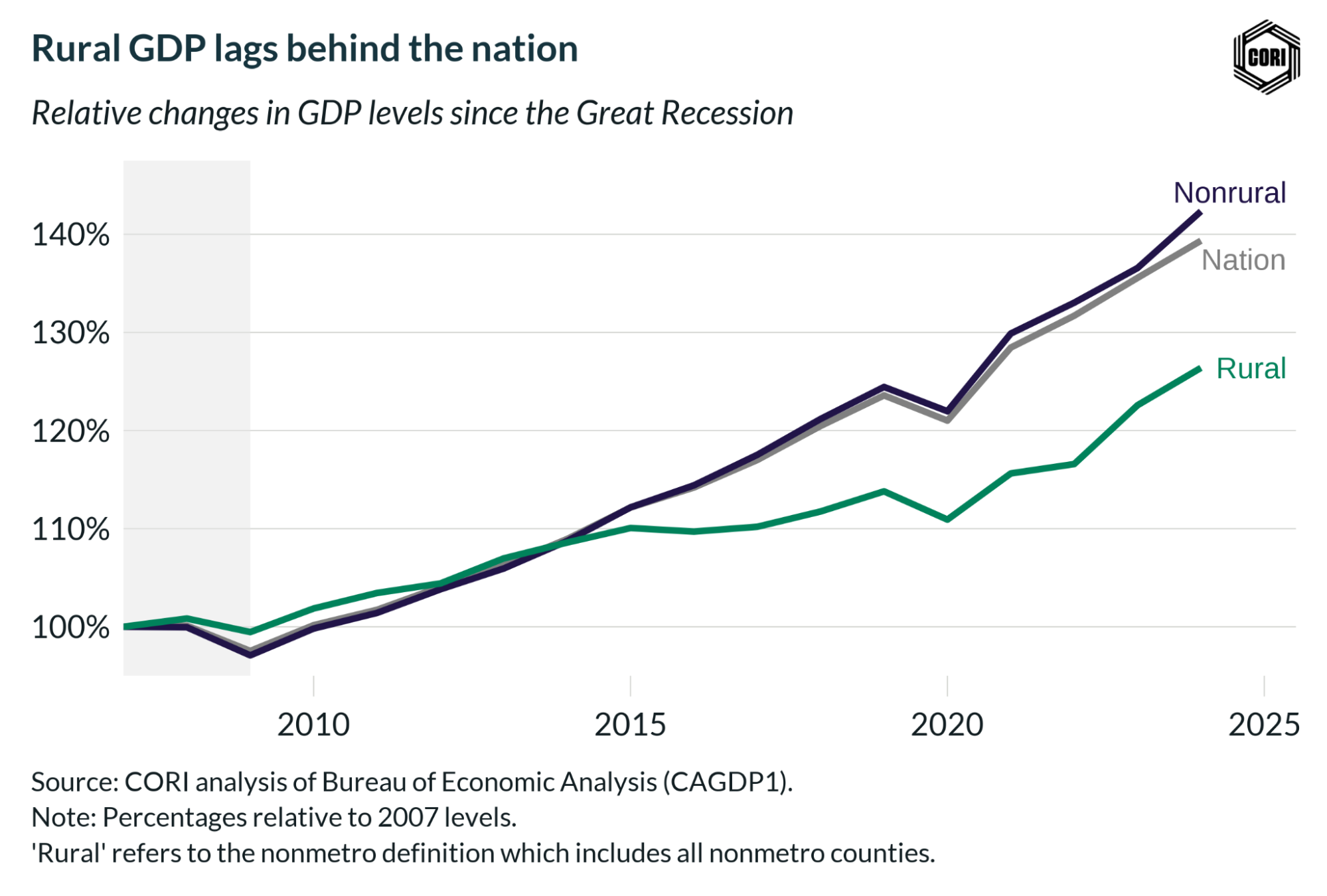
Rural America is producing more. From 2022 to 2024, rural Gross Domestic Product (GDP) grew 8.4% (about 4.1% per year), outpacing the 7.0% growth in nonrural areas.
But this recent acceleration doesn’t close the gap that has widened over nearly two decades. Since 2007, nonrural GDP has grown at roughly 2.1% per year, while rural GDP has grown at about 1.4% per year, on average.
However, GDP does not tell the whole story.
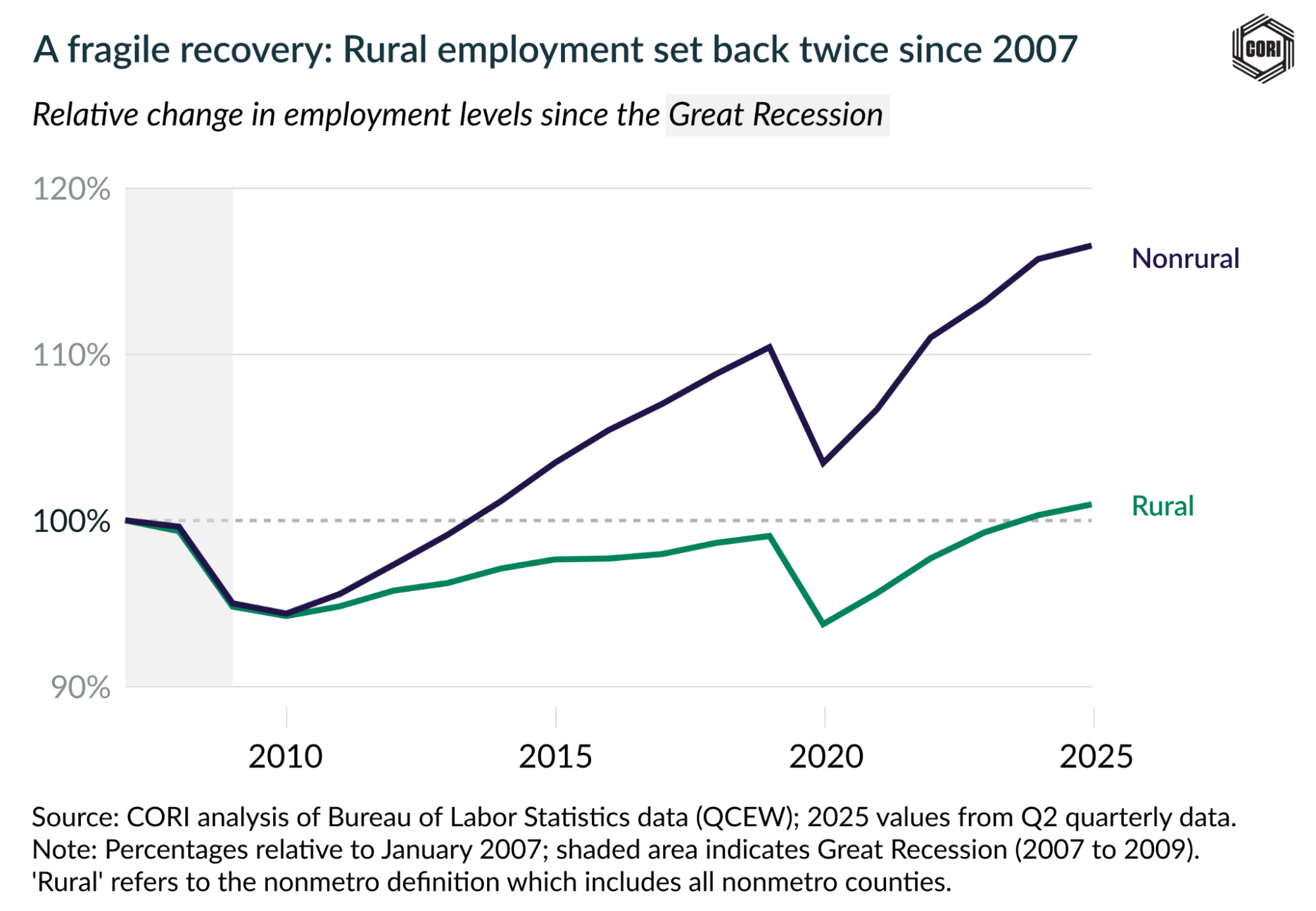
During the same period, job growth did not keep pace. From 2023 to 2024, rural employment grew by 1%, compared with 2.3% in nonrural areas. By 2024 to Q2 2025, job growth had cooled to 0.7% in both rural and nonrural areas.
By 2025, rural employment was just 0.2% above its pre-Great Recession 2007 level. By contrast, nonrural employment had grown by roughly 16% over the same period.
That gap matters.
A community can produce more without creating proportionally more jobs. It can show growth on paper while families still face high costs, limited career paths, and wages that lag behind the rest of the country.
Rural wage and income gaps remain clear. Average annual wages are about $52,000 in rural areas, compared with $75,000 in nonrural areas. And these averages obscure substantial variation within rural communities, where income inequality has historically been higher than in urban counties.
That is the rural growth paradox: output is rising, but prosperity is not reaching every worker, household, or region. Economists have long documented this kind of gap between rising output and lagging employment and wages – a pattern called jobless growth or wage-productivity decoupling.
The disconnect is also showing up in how workers describe their lives. National consumer sentiment has held near its all-time low through early 2026, according to the University of Michigan’s long-running Consumer Sentiment Index. Rural workers in particular report less long-term optimism than their urban counterparts: only 34% of rural workers expect more career opportunities over the next five years, compared with 54% of urban workers.
As Amanda Weinstein, CORI’s Director of Research, puts it, “growth is national; economic reality is local.”
For rural leaders, the question cannot be only, “Is the economy growing?” It has to be, “Who is benefiting from that growth?”
Structural barriers are holding many rural places back.
The challenge is not that rural America lacks ambition or assets. Rural communities have talent, strong institutions, and the entrepreneurial energy to build on them.
But many rural places face structural barriers that shape who benefits from growth.
One major barrier is industry concentration. Rural counties are more likely than nonrural counties to have high concentrations of farming, manufacturing, or mining (the tradable goods sector). The USDA Economic Research Service classifies roughly a quarter of rural counties as manufacturing-dependent and 17% as farm-dependent. These industries are essential. They feed, power, and build the country, and they have provided generations of rural workers with good jobs and stable incomes. But they are also sectors where productivity can grow substantially without adding many jobs. Decades of automation, mechanization, and changes to trade exposure have meant the same farm, factory, or mine can now produce more with fewer workers. In rural manufacturing alone, employment fell roughly 30% between 2001 and 2015, even as the sector kept producing. Higher output can raise local GDP without creating more paychecks, higher wages, more local businesses, or more household wealth, especially when those businesses are not locally owned.
Industry concentration also makes rural places more exposed to forces outside local control, including commodity prices, energy demand, tariffs, automation, supply chains, and global markets. U.S. counties that have been more exposed to import competition after 2001 lost manufacturing jobs faster and saw slower recoveries, with rural manufacturing-dependent counties hit especially hard.
Tradable services — jobs and businesses that can sell beyond the local market — are growing, but they still tilt toward nonrural areas. These jobs often include tech, professional services, finance, software, design, and other higher-wage work that can bring outside income into a community. Recent research finds that since 1980, US wage growth in skilled service industries has been concentrated in dense cities, nearly doubling the urban-rural wage gap.
Rural communities need more ways to grow beyond local demand. A small town can only support so many local-serving businesses. But a rural tech firm, design shop, accounting company, or digital service provider, by contrast, can reach customers anywhere – and bring in income with each customer.
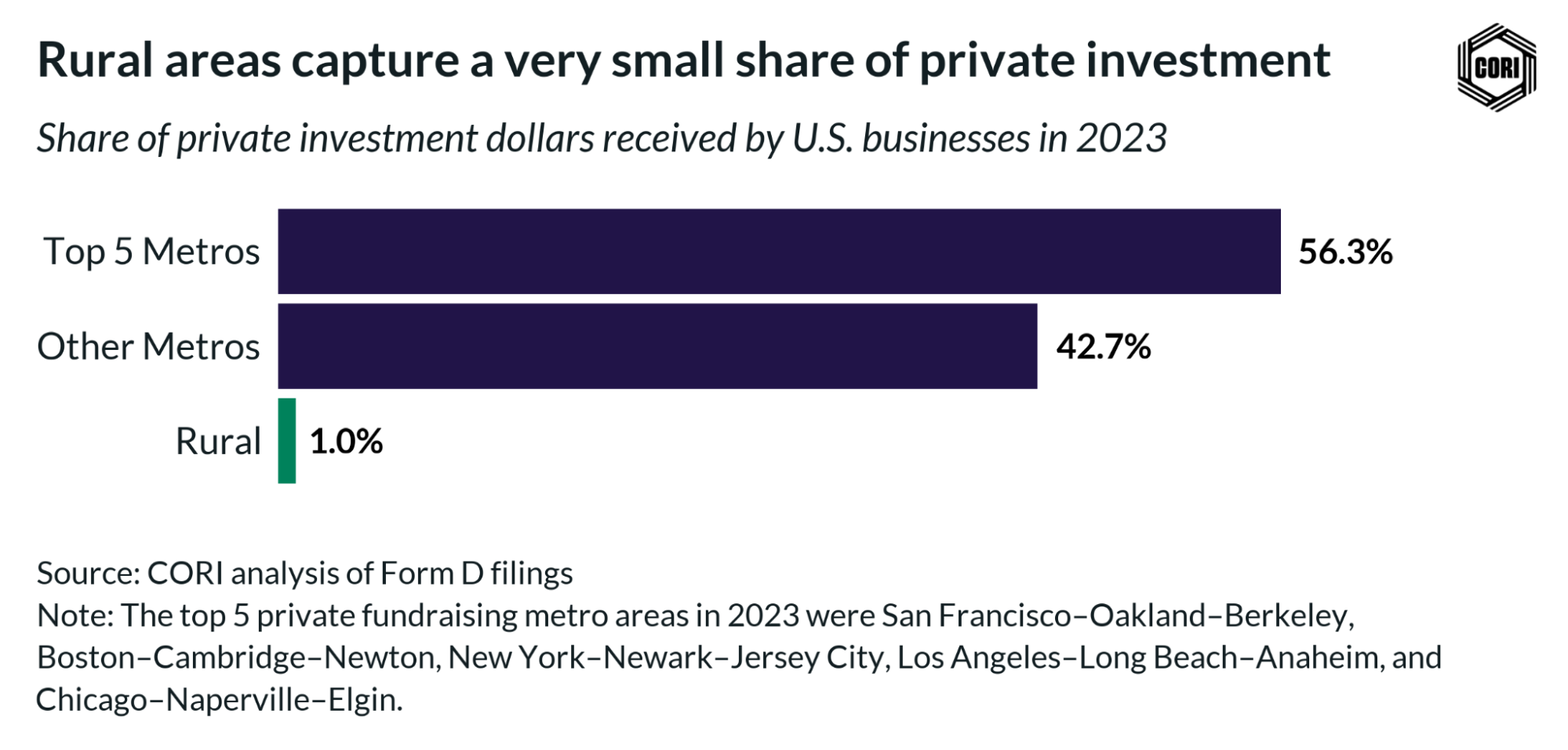
Capital access is another barrier. Rural areas receive just 1% of U.S. private investment dollars, even though they are home to roughly 14% of the population and 12% of U.S. businesses. On the lending side, the share of bank assets held by community banks fell sharply between 1996 and 2017, and rural small businesses – which often depend on community banks and relational lending more than larger firms do – have felt that decline most directly. Tradable service businesses, which rely more heavily on venture capital than on bank loans, face the sharpest gap of all.
Remote work is uniquely suited to rural places: it is geographically unconstrained, and many of these roles don’t require a college degree. Tech jobs offer the broadest access, with 63% of roles allowing remote work, but the opportunity extends well beyond tech. This matters because in an annual survey published in the Washington Post, 30% of movers are seeking rural locations. Workers who bring high-wage jobs with them effectively import income into rural economies, supporting local restaurants, healthcare, retail, and other services that anchor a small community. Return-to-office mandates from major employers could negatively influence this channel, potentially narrowing rural access to high-wage remote work. But a small influx of higher-earning residents into a small town can noticeably raise housing costs for everyone, which is why it’s not enough to attract remote workers from elsewhere. Existing residents need access to the training and pathways that make high-paying remote work available to them too.
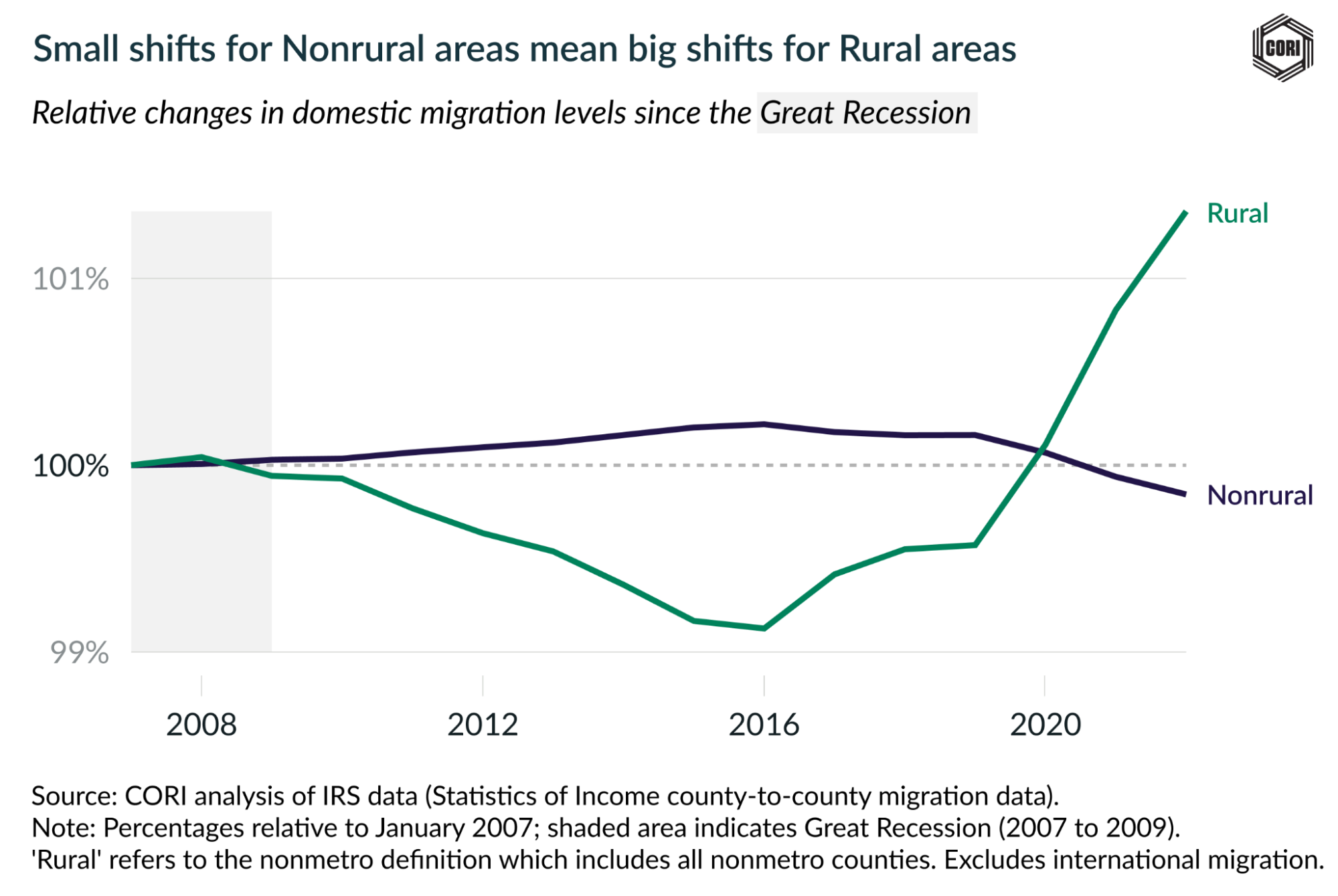
None of this is possible without broadband. Remote work depends on reliable high-speed internet at home, and for much of rural America that access simply didn’t exist—a gap the COVID-19 pandemic made impossible to ignore. The crisis spurred significant investment in rural broadband expansion, and connectivity has meaningfully improved as a result. But broadband alone isn’t sufficient. Rural communities also need the tools, talent, capital, and business support to turn connectivity into jobs, startups, and stronger local economies.
Which barriers matter most, and which assets are available to work around them, varies sharply by region.
Rural momentum is growing, and the West is driving much of it.
Rural America is not one economy.
Some regions are gaining jobs, population, and seeing real momentum in tradable services. Others face deepening industry concentration, slower growth, and fewer entry points into the sectors driving the broader recovery.
The rural West stands out.
Rural job growth has been strongest in the West. By 2025, rural West employment was roughly 8% above its pre-Great Recession 2007 level, while rural employment overall was just 0.2% above. Employment in tradable services is also expanding faster in the West than in any other rural region. Population growth has been gradual and sustained – not a pandemic blip, but a steady shift.
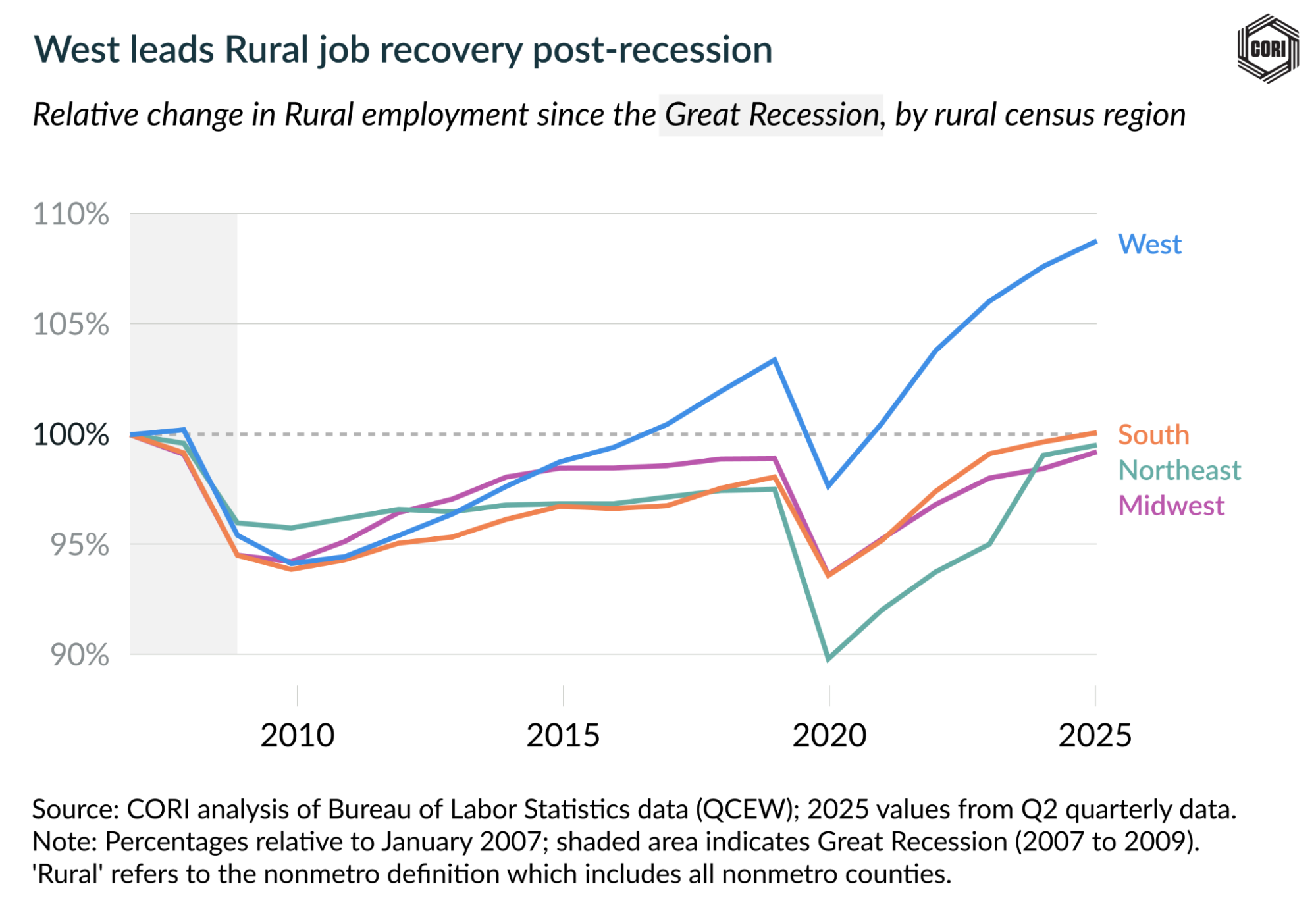
This momentum draws on multiple forces. Quality of life and outdoor economies retain and attract talent. High-amenity places, especially in the rural Mountain West, have been better positioned to attract skilled workers and support new business formation. Since 2012, the number of businesses in the rural West has grown by roughly 9.1%, compared to 1.6% in rural America overall.
The Mountain West isn’t a template for every rural community, and the growth there isn’t without costs.
Growth brings pressure. Housing costs rise, infrastructure strains, and longtime residents can find themselves priced out of the communities they helped build. New opportunities may not reach everyone without programs that widen access to higher-paying jobs, such as tech jobs, and support entrepreneurship, so existing residents can start their own businesses.
But the West shows something important: rural momentum can build when local assets connect to the industries, workers, and businesses that are growing now. In the rural West, the share of workers working from home rose from 7% in 2019 to 12% in 2024 – the highest of any rural region. It is also the only rural region where tradable services employment has fully recovered to its pre-Great Recession level.
Other regions show different patterns. The rural Northeast saw a sudden population surge during COVID, driven by remote work. Many rural Midwestern communities continue to build on strong agriculture and manufacturing assets expanding into advanced manufacturing, robotics, and ag-tech.
The lesson is not that every rural community needs to follow in the West’s footsteps. Instead, every rural place needs to understand its own path forward to grow more diverse and innovative local economies from the ground up.
That means first assessing a community’s assets and barriers, then building a strategy grounded in local conditions, connecting and leveraging existing strengths, addressing what stands in the way, and developing the infrastructure and programs needed to grow a skilled workforce and support new businesses. That is the work of place-based economic development.
What rural leaders should do with these trends
The data points to a practical shift for rural economic development.
The data center boom makes the stakes concrete. Rural land, rural power, and rural broadband are being mobilized at scale to support AI systems built by, and primarily serving, companies and workers elsewhere. That’s a version of a familiar pattern in rural economic history: the output leaves, the costs stay. Investment in rural infrastructure is not the same as investment in rural people, and rural communities shouldn’t have to settle for being the server room of the national innovation economy without true investment that benefits their communities and allows them to leverage the opportunity. That means the infrastructure investments rural communities actually need to participate: affordable fiber broadband, flexible workforce training that upskills workers and opens pathways into tech careers, and entrepreneurship support that helps rural startups launch and leverage new tools like AI to grow and compete from wherever they are. It means investing directly in rural innovation, so that rural Americans are among the drivers of what the AI-powered economy produces — and so that the solutions to rural challenges come from rural people, not just from technologies designed elsewhere and delivered to them.
Rural communities are remarkably varied and do not need generic playbooks. They need local strategies built around local assets, local barriers, and local goals.
That starts with better questions:
- What is driving growth in our local economy, and are those sectors creating jobs and rising wages?
- Is the economy overly dependent on one or two industries, or building strength in tradable services that can reach customers beyond the local market?
- Can local businesses and entrepreneurs access the capital they need to grow?
- Is broadband translating into measurable business and job gains – and can residents access remote or hybrid work?
- Are housing, childcare, and transportation expanding opportunity, or blocking it?
- And – most importantly – who is benefiting from growth, and who is being left out?
Rural growth is the starting point, not the finish line. The real measure is what that growth produces locally.
The practical shift is real. When local strategies translate growth into local jobs, local businesses, and local wealth, the gap between national headlines and what people actually experience on Main Street and in their wallets begins to close.
Rural America has the assets. The work is in building the systems that turn those assets into jobs, businesses, and wealth that benefit the community.
For more on rural economic trends, watch CORI’s 2026 State of Rural America webinar by Dr. Amanda Weinstein.