

Big Climate Solutions, Small-Town Launchpad: Verde’s Breakout Year in Rural Vermont
Big climate breakthroughs aren’t just happening in big cities. In rural Vermont, Verde Technologies is scaling next-generation solar technology that’s lighter, more flexible, and poised to reshape how the world produces clean energy.

When most people think about breakthrough climate technology, they often picture sprawling labs in major metro hubs. Verde Technologies is proving a different story, one where world-class innovation and the next generation of clean energy are being built and scaled in the rural town of Waterbury, Vermont.
As a portfolio company of the CORI Innovation Fund and the Green Mountain Accelerator Fund, Verde exemplifies what’s possible when high-potential rural startups have access to the capital, partnerships, and ecosystem support they need to grow.
A Transformational Year in 2025
This year marked a pivotal shift for Verde: from lab development to real-world production and commercial execution.
In 2025, the company successfully completed and commissioned its pilot manufacturing line in Waterbury. By Q3, Verde had moved firmly into pilot-scale execution, producing larger-area perovskite solar cells and flexible modules. This transition unlocked meaningful commercial traction, new partnerships, and early revenue streams, major milestones for an advanced materials startup.
The company continued to raise capital, enabling Verde not only to acquire its pilot line as planned, but also to fully commission operations and launch fabrication this year. Even with short-term commissioning delays, the team stayed disciplined, keeping operating cash burn on plan while surpassing January revenue forecasts.
Today, the Waterbury facility places Verde among a small, elite group of organizations worldwide that are developing perovskite solar photovoltaics at a higher Technology Readiness Level (TRL). That’s a remarkable achievement, made possible through the support of investors who believe rural innovation can compete on a global stage.
Breakthrough Technology, Built in Rural Vermont
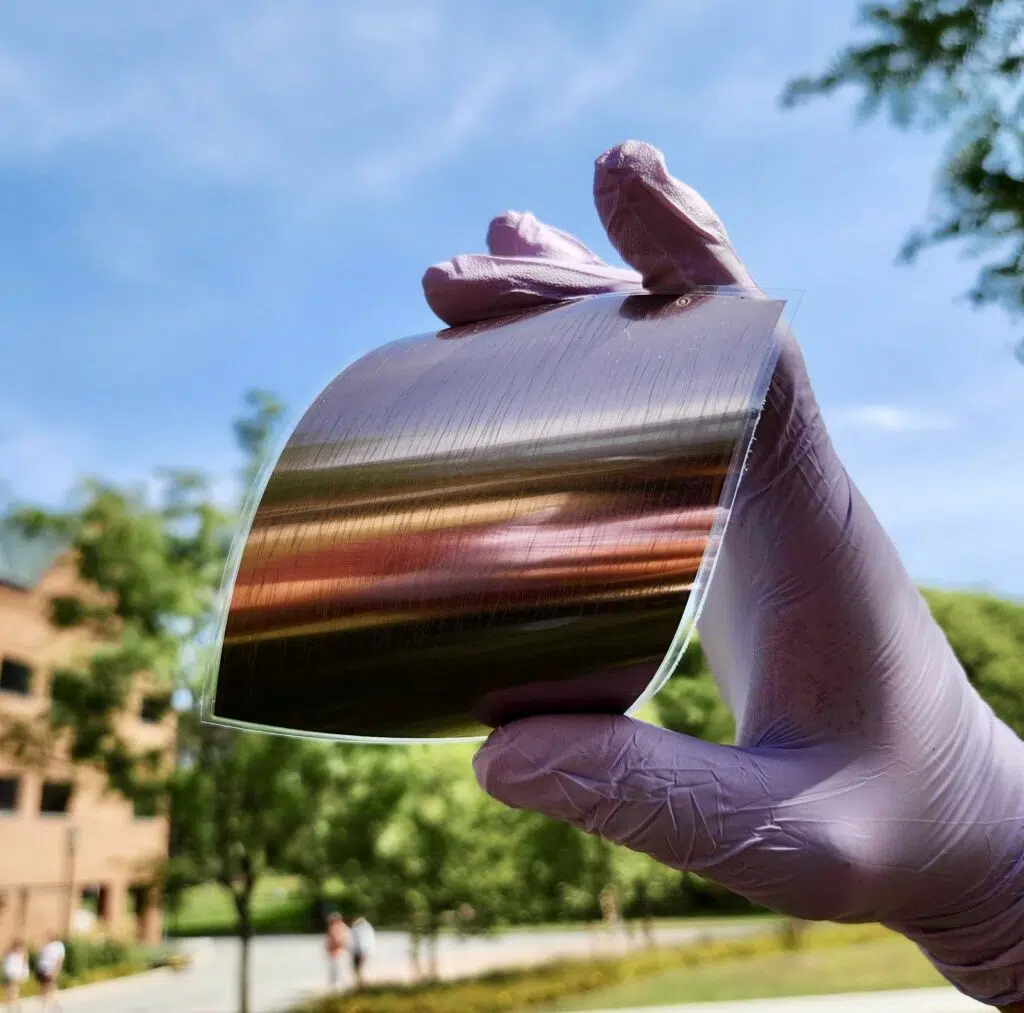
Verde is redefining how solar panels are made. Its lightweight, flexible perovskite modules offer lower cost, higher efficiency, and significantly less mass than traditional silicon panels — opening the door to entirely new applications.
This year, Verde fabricated functional mini-modules on flexible substrates exceeding 16% power conversion efficiency (PCE), which is in line with the PCE of traditional rigid silicon panels, using processes aligned with scaled manufacturing. These modules meet the company’s MVP (Minimally Viable Product) panel design specifications and form the foundation of Verde Repowering™, a concept aimed at upgrading degraded and underperforming solar installations.
The opportunity is massive. The global market for underperforming solar assets is projected to approach $200B by 2030, with an estimated $25B serviceable market in the U.S. alone. Verde is now working with solar industry partners to advance early pilot projects and define the assembly and productization pathway for these next-generation panels.
Commercial Momentum Across Key Sectors
Verde’s technical progress is translating into real market validation.
- A previous memorandum of understanding with a major aerospace OEM has evolved into a formal agreement, with initial device batches delivered and revenue generated. This collaboration will validate Verde’s perovskite technology in demanding aerospace environments, with funded deliverables extending into 2026.
- The company signed a joint development agreement with a leading thin-film solar manufacturer to enhance module stability and scalability for mass production.
- Verde earned a U.S. Department of Defense xTechSearch award, advancing toward a potential SBIR contract and underscoring the strategic importance of domestically sourced thin-film solar products.
Together, these agreements signal Verde’s transition from R&D to active customer programs and funded development — a critical step toward scaling and product-market readiness.
Recognition on a National Stage
The broader climate-tech ecosystem is taking notice.
- The Alliance for Climate Technology (ACT) named Verde a top climate-tech company to watch beyond 2025
- Vermont Edition highlighted Verde among the high-growth companies choosing to build in Waterbury
- Dr. Pramod Baral, a key member of Verde’s team, received recognition for his extraordinary journey in advancing cutting-edge solar technology
These honors reflect both technical leadership and the human stories behind rural innovation.
Positioned for a Surging Energy Future
Verde’s momentum comes at a time when global demand for clean electricity is accelerating rapidly. Outside the U.S., solar markets remain robust, and internationally, there is growing policy support for perovskite manufacturing and deployment, particularly in countries like Japan.
In the U.S., rising electricity demand from data centers, hyperscalers, and AI infrastructure is reshaping the energy landscape. Utility-scale solar output continues to grow rapidly in leading states, reinforcing the role that low-cost renewable energy will play in powering the next generation of digital infrastructure.
Against this backdrop, Verde’s lightweight, high-efficiency, flexible modules that can be efficiently produced domestically offer a compelling path forward, especially for repowering existing solar assets and enabling applications where traditional panels fall short.
What Verde’s Growth Means for Rural Innovation
Verde Technologies is more than a climate-tech success story. It is proof that transformative, globally relevant technology companies can start, scale, and manufacture in rural America.
With the support of CORI’s Innovation Fund and its investor community, Verde has built advanced manufacturing capability in rural Vermont, created high-skill jobs, attracted national and international partnerships, and positioned itself at the forefront of next-generation solar.
This is the future CORI is working toward: rural communities not on the sidelines of innovation, but leading it.